

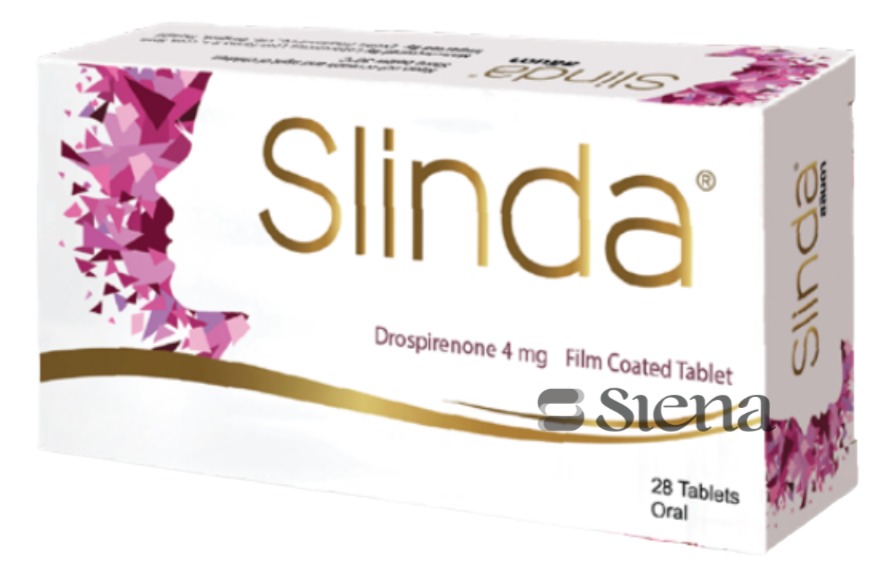
The drospirenone progesterone-only pill (POP)— sold in Australia as Slinda — is recommended for women who cannot use oestrogen-containing contraceptives. That includes women who experience migraine with aura, have a history of thrombosis, or who smoke and are overweight.
This article covers the drospirenone POP (Slinda) specifically — not the older levonorgestrel or norethisterone progesterone-only pills, which work differently.
Slinda works similarly to the combined oral contraceptive pill: it suppresses ovulation, thickens cervical mucusmucous, and thins the uterine lining. Because it contains no oestrogen, it can be used with greater confidence in women for whom oestrogen carries additional risk such as those with a history of blood clots.
| “Slinda has a contraceptive efficacy of 99% with perfect use, and approximately 91% with typical use. One of its key advantages over older POPs is the larger window for a missed pill — 24 hours, compared to just 3 hours with older formulations.“ |
Each pack contains 24 white active hormone tablets and 4 green inactive placebo tablets. Slinda is now currently available by private prescription only. It is not listed on the PBS, so there is an out-of-pocket cost to consider when discussing your options with your doctor.
If you and your doctor have decided Slinda is right for you, here is what you need to know about getting started.
Starting Slinda for the First Time
How you start Slinda, and whether you are covered for contraception immediately, depends on what you are switching from.
If you have not used hormonal contraception in the last month
Start your first Slinda tablet on day one of your period and you will be protected straight away. If you start on any other day of your cycle, you will need to take seven days of active (white) pills before Slinda can be relied on for contraception. During those seven days, use a barrier method such as a condom.
If you are switching from a combined pill or vaginal ring
Start Slinda the day after your last active combined pill, or on the same day you remove your vaginal ring, and you are covered immediately. If there is a gap of more than one day between stopping your previous method and starting Slinda, allow seven days of active pills before relying on it, and use a barrier method in the meantime.
If you are switching from another progestogen-only pill (such as levonorgestrel)
Stop your current pill and start Slinda the following day. You will be covered for contraception immediately with no gap required.
If you are having an IUD or implant removed
Take your first Slinda tablet on the day of removal and you will be protected straight away.
If you have been using depot injections
Take your first Slinda tablet on the day your next injection would have been due. Starting on that day means you are covered immediately.
After having a baby
You can start Slinda between day 21 and day 28 after giving birth and be covered straight away. If it has been longer than 28 days since delivery, take seven days of active pills first, use a barrier method during that time, and take a urine pregnancy test before relying on Slinda as contraception.
Missed Pill Rules
One of Slinda’s practical advantages is its more forgiving missed-pill window.
If you are less than 24 hours late
Take the missed pill as soon as you remember. You are still covered for contraception. Continue taking the rest of the pack as usual.
If you are more than 24 hours late
Take the missed pill as soon as you remember — even if that means taking two tablets in one day. Continue the pack as normal, but use a barrier method such as a condom for the next seven days, as your contraceptive cover may be reduced
If you have had severe vomiting or diarrhoea
Treat this the same as a missed pill — your body may not have absorbed the tablet properly. Apply the rules above based on the timing, and use a barrier method for seven days.
Frequently Asked Questions About Slinda
Is Slinda safe to take while breastfeeding?
Yes. Slinda is considered safe for breastfeeding mothers.
Can all women take Slinda?
Most women can. The main contraindication is an active blood clot. Importantly, Slinda is considered safe for women with other risk factors that might rule out the combined pill — including smokers, women with obesity, and those with a family history of blood clots.
Is Slinda reversible?
Yes. Slinda is immediately reversible — fertility returns as soon as you stop taking it.
What will happen to my periods?
Like most hormonal contraceptives, Slinda tends to make periods lighter. There is approximately a 50% chance that periods will stop altogether within the first year of use. Some women experience light breakthrough bleeding, which can usually be managed with a liner. Once you stop taking Slinda, your usual period pattern typically returns.